|
Casting on for brioche
If you're like me, you love working brioche stitches, but aren't as crazy about the oft-suggested Italian cast-on. While it's pretty easy to work, it's not always easy to work from. It can be hard to tell which strands are the stitches and which strands are the strands between stitches.
I prefer a tubular cast-on, which is beautiful for any k1-p1 rib. And it also makes a tidy-looking and clear start for a brioche project.
A standard tubular cast-on, however, is a too snug for the spacious brioche stitch, which is why I've adapted tubular cast-on techniques especially for brioche knitting. On this page we work a tubular cast-on for 2-color brioche projects worked in the round. Also see these links for
- 1-color brioche worked flat
- 1-color brioche in the round
- 2-color brioche worked flat
Tubular Cast-on for 2-Color Brioche - worked in the round
I'm unorthodox in the way I work 2-color brioche in the round. The standard way is to work a dominant color (CA) round knitwise (brk 1, slyo, repeating), then work a background color (CB) purlwise (slyo, brp 1, repeating).
I prefer working back and forth, with each round worked knitwise.
That is, I first work a CA rnd repeating [brk, slyo] to the end; then bring the yarn to the front and turn the work to the other side.
Now work a CB rnd repeating [brk, slyo] to end; then bring the yarn to the front and turn the work to the other side.
The colors spiral around in opposite directions. And there are no weird beginning-of-round or end-of-round issues as you might have if working one knitwise round followed by one purlwise round. It's a pretty nifty technique - and you can use the same trick for working garter stitch in the round without ever purling.
The following cast-on sets up for this way of working.
(To modify it for working in the standard knit-1-rnd-purl-1-rnd fashion, you'll work the CB pick-up round with dominant side A facing, purling picked up stitches, and slipping CA sts with yarn in back.)
To work:
With smooth scrap yarn and needles a size or two larger than gauge needles, cast on half-the-number-of-stitches-desired.
Join and knit 2 rnds plus a few stitches in scrap yarn.
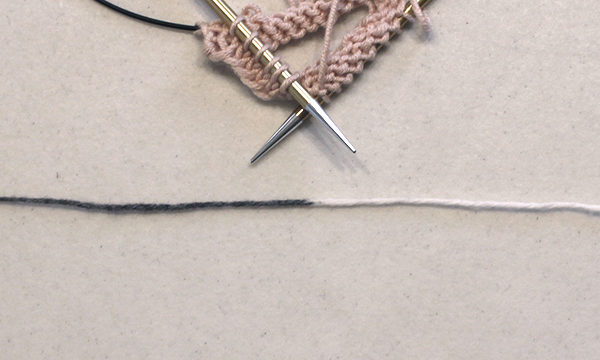
Setting knitting aside for a moment, join dominant color strand (CA) with background color (CB); Russian join is recommended.
Here, white is the dominant color and gray is the background color.
With CA knit 1 rnd into waste yarn sts.
Switch to gauge-size needles and cont with CA, knit 2 rnds.

Bring yarn to front, then turn work to other side.

Using CB strand:* bring ytb, locate CA purl bump between last stitch on RN and first stitch on LN in the first CA round (right next to waste yarn),

insert left needle tip into purl bump from top to bottom and knit into it through its back loop,

wyf sl1; rep from * to end;

bring yarn to front, then turn work to other side (CA dominant).
Cast-on is complete, and desired number of stitches should now be on needle, all ready to start brioching!
Setup Rnd A: [k1, slyo] to end; bring yarn to front, turn work to side B.
Setup Rnd B: [brk, slyo] to end; bring yarn to front, turn work to side A.
Rnd 1A: [brk, slyo] to end; bring yarn to front, turn work to side B.
Rnd 1B: [brk, slyo] to end; bring yarn to front, turn work to side A.
Repeat Rnds 1A and 1B.
To remove waste yarn:
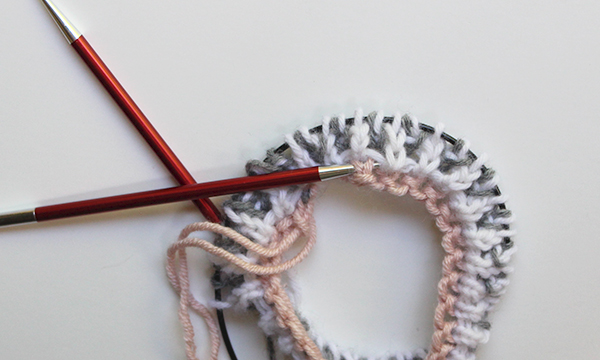
Starting at the looped end of the waste yarn, pull the strand closest to the working yarn, drawing it through.
Once that strand has been pulled out, the wast-yarn cast-on row will fall away.
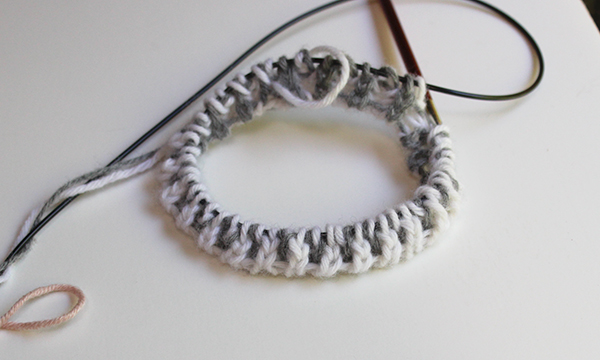
Finished edge.
Brioche Terms
Basic Brioche Abbreviations
brk - brioche knit: Knit next double-stranded stitch with both strands together, as if it were one stitch.
brp - brioche purl: Purl next double-stranded stitch with both strands together, as if it were one stitch.
slyo - create a yarnover while at the same time slipping a stitch: Ytf, sl 1 (purlwise), bring ytb above the needle so that it crosses diagonally over the top of the slipped stitch.
Notes on the slyo: The slyo results in a double-stranded stitch (the slipped stitch together with its yarnover will form a narrow "X" above the needle) and those double strands will be worked together on the next row or round - either as a brk or brp, or as part of an increase or decrease.
Depending on ones knitting method, the slip and the yarnover portions may be worked nearly simultaneously.
- When the slyo is worked before a knit or brk stitch, the yo is a partial yarnover, moving just from front to back above the needle, ready to work the knit stitch.
- When the slyo is worked before a purl or brp stitch, the yo forms a complete yarnover - moving from front to back above the needle, then to the front under the needle ready to work the purl stitch.
Brioche increases
brinc - brioche increase: Brk 1 leaving left st on ndl, yo, brk 1 removing st from ndl (increases 2 sts) (aka: brkyobrk).
dbl-brinc - double brioche increase: * Brk 1 leaving left st on ndl, yo; rep from * once more, brk 1 removing st from ndl (increases 4 sts) (aka: brkyobrkyobrk)
Brioche decreases - Important note: When working the following decreases, the double-stranded slyo from the previous row or round is treated as one single stitch.
brLdec - left leaning brioche decrease: Sl 1 knitwise, k2tog, pass slipped stitch over knitted stitch (decreases 2 sts) (aka: brLsl dec)
brRdec - right leaning brioche decrease: Ssk, slip stitch just worked back onto left needle, pass 2nd stitch on left needle over slipped stitch, slip stitch to right needle (decreases 2 sts)
(this decrease mirrors the brLdec. It has a similar result but is worked somewhat differently than a brRsl dec).
More Resources: These terms are just a few basics. For a comprensive guide to all things brioche, see Nancy Marchants lovely website: www.briochestitch.com.
|
